
But the Congress said its leader Priyanka Gandhi Vadra will attend the event.

Thousands of farmers have reached the national capital on their tractor-trolleys and other vehicles, responding to the 'Delhi Chalo' call against the agri-marketing laws enacted at the Centre in September. On Saturday morning, it wasn't clear if they will agree to move to the Burari ground on the outskirts of the city, where police said they can continue with their protest. Many protesters were demanding a better venue in the centre of Delhi. Originally, the protest was meant to be on November 26 and 27.
'On January 22, when the last round of talks took place, the farmer leaders were told by Agriculture Minister Narendra Singh Tomar that the government is also prepared.' 'And they did this.'

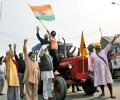
Farmers flaunting colourful turbans, sunshades, long beards and twirling moustaches danced on tractors, distributed sweets and hugged each other to mark the occasion that seemed like a festival.
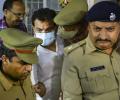
Ashish Mishra, son of Union minister of state for home Ajay Mishra, was produced before a court here late on Saturday night, which sent him to 14-day judicial custody in connection with the October 3 Lakhimpur violence.
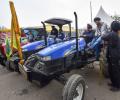
The Republic Day tractor parade by agitating farmers will feature a number of tableaux from across states depicting village life, the protest against the Centre's contentious farm laws, and hailing their courage, according to organisers.

One lakh copies of the three agri laws were burnt at the Singhu border alone, said Paramjeet Singh of Samyukta Kisan Morcha.

No improvement in the air quality in Delhi-NCR is expected for another three days, authorities said on Monday, as the Supreme Court directed the Centre to call an emergency meeting to decide on measures like stopping non-essential constructions, transport and power plants by Tuesday evening.
Congress leader Manish Tewari demanded that the government should provide Rs 5 crore compensation to the families of the farmers who died during the farm laws agitation

Multiple layers of iron and cement barricades, and at least five layers of concertina wires were put up last year, and further strengthened after the January 26 violence this year during the farmers' protest against the three contentious farm laws.
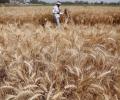
The surge in wheat export from India owing to the Ukraine crisis has once again demonstrated how farmers in states that have flexible marketing frameworks and low taxes benefit more from an emerging situation. The bulk of the wheat exported from India, trade and industry sources say, is being sourced at rates significantly higher than the state-mandated price of Rs 2,015 per quintal in Madhya Pradesh (MP), Uttar Pradesh (UP), and Gujarat - states which have low mandi taxes compared to Punjab and Haryana. This is not only benefiting farmers there but could also lead to significant savings for the states in procurement costs in the months to come.

The mortal remains of Lakhbir Singh were cremated at his native village in Punjab's Tarn Taran amid tight security in the presence of his family members. No Sikh priest was present to perform Ardas (Sikh religious prayer) and no one from his village, Cheema Kalan, attended the last rites.

"They did business of temple, religion and feelings. Now, they want to do the business on hunger," Tikait alleged.

He maintained that the laws were for their benefit and then apologised to people of the country, adding that the government could not convince a section of farmers despite its clear heart and clean conscience.
'Only then will we withdraw the agitation.'
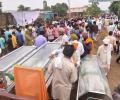
The Uttar Pradesh government grappled on Monday with the aftermath of violence during a farmers protest in Lakhimpur Kheri, lodging a case against Union minister Ajay Mishra's son, promising a probe by a retired high court judge and stopping opposition leaders from reaching the trouble spot.
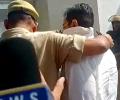
Union Minister Ajay Mishra's son Ashish Mishra on Saturday appeared before the special investigation team (SIT) formed in connection with the Lakhimpur Kheri violence case.

The Samyukta Kisan Morcha (SKM), a forum comprising 40 farmer unions, called for a Bharat Bandh on Monday against the Centre's three agriculture laws. Here is its impact across the country:
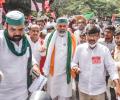
'Have you seen a situation like this anywhere before, globally or in India, where a government says, okay, we are withdrawing a law because you don't want it?'

From the Republic Day violence to Lakhimpur Kheri incident and terms such as 'toolkit' and andolanjeevi entering the Indian political lexicon, it was controversies galore during the year-long farmers' movement against the contentious agri laws.
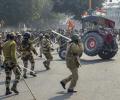
The Delhi Police claimed that Disha Ravi, who was arrested by a Cyber Cell team of the force on Saturday, was an editor of the 'toolkit Google doc' and 'key conspirator' in the document's formulation and dissemination.

Road and rail traffic was partially affected in some regions on Monday during a 'Bharat bandh' called against the Agnipath military recruitment scheme, while protests appeared to taper off in many states, with authorities stepping up security and imposing curbs after days of unrest.

If Modi's political retreat -- he has tried to avoid a pre-1984 type of situation in Punjab -- helps soothe Sikh sentiments, nobody should complain Modi, asserts Sheela Bhatt.

With the talks between the Centre and the agitating farmer unions stalled since January, Agriculture Minister Narendra Singh Tomar on Wednesday expressed readiness to resume the dialogue to resolve their objections to the three new agri laws, but the unions remained adamant on their demands for a repeal of the legislations and a legal guarantee on the minimum support price.

Several Delhi hospitals treating Covid-19 patients faced a major medical oxygen crisis with their depleting stock for the second consecutive day, prompting the Centre to increase the city's quota to 480 metric tonnes against the AAP dispensation's demand of 700 MT.

'The protesters took out a march carrying black flags. They burnt Prime Minister Narendra Modi's effigy while raising slogans against the three farm laws'

As many as 37 farmer leaders, including Rakesh Tikait, Yogendra Yadav, Darshan Pal and Gurnam Singh Chaduni, have been named in a first information report in connection with the violence during the tractor parade that left 300 police personnel injured even as two farmer unions on Wednesday withdrew from the agitation against the farm laws.
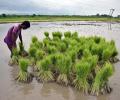
Among the key demands of agitating farmers has been a legal guarantee on minimum support price (MSP). The protest reached a crescendo when thousands of farmers from Punjab and elsewhere marched towards Delhi late last year and decided to block the main entry points once they were denied entry. The Centre, on its part, held 11 rounds of discussions with the protesters and even offered to amend some of the provisions without much success. With now one of their chief demands met, farmers have now moved on to force the government to concede on MSP.

The farmers' tractor rally - Kisaan Parade - against the farm laws was expected to be held after 12 pm. However, huge crowds gathered on the borders at around 8 am.
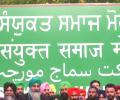
Chaduni has made known his displeasure days after talks between his outfit SSP and Rajewal-led SSM for a pre-poll alliance for the state assembly polls.

Prominent international celebrities and activists on Wednesday joined American pop star Rihanna to extend support to the farmers' protests here and garner international attention on the protracted stir but their remarks were slammed by India as 'neither accurate nor responsible'.

"Farmers would like to remind the PM that it is 'andolans' that have liberated India from colonial rulers and that is why we are proud to be 'Andolan-jivi'."

Several trains were cancelled, highways and key roads blocked and many thousands stranded for hours on Monday as a nationwide 10-hour shutdown against the Centre's three agri laws disrupted lives across parts of India, particularly in the north.

Emotions ran high as the farmers performed ardas (prayers) and havan to thank the almighty and started their 'victory march' from Singhu, Tikri and Ghazipur protest sites to Punjab, Haryana and Uttar Pradesh in convoys of tractors, bedecked with colourful flowers and lights and blaring songs of jubilation.
 © 2026 Rediff.com - Advertise with us - Disclaimer - Privacy Policy - Sitemap - Feedback - About us - Terms of use - Grievances